
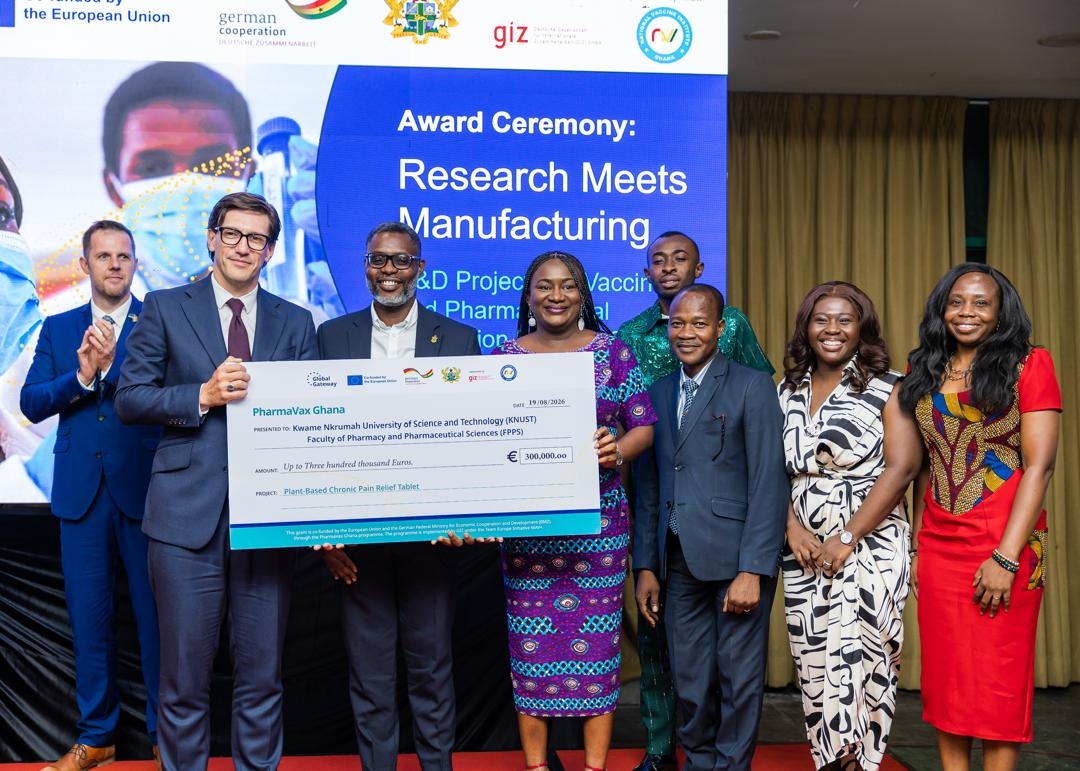
The Kwame Nkrumah University of Science and Technology (KNUST), through its Faculty of Pharmacy and Pharmaceutical Sciences under the College of Health Sciences (CHS), is leading a €300,000 research and innovation project to develop a scalable, locally manufactured herbal medicine for pain management.
The project is being implemented under the PharmaVax Ghana Programme, a major initiative aimed at strengthening pharmaceutical research, innovation and local manufacturing capacity in Ghana. The grant was announced at an award ceremony jointly organised by the National Vaccine Institute (NVI) and the Deutsche Gesellschaft für Internationale Zusammenarbeit (GIZ) on August 19, 2026.
Funded by the German Federal Ministry for Economic Cooperation and Development (BMZ) and the European Union (EU), the PharmaVax Ghana Programme supports collaborations among academia, research institutions and industry to accelerate the development and manufacture of innovative health products in Ghana.
KNUST is implementing the two-year project in partnership with Aspee Pharmaceuticals and the Biotechnology and Nuclear Agriculture Research Institute (BNARI) of the Ghana Atomic Energy Commission (GAEC). The KNUST-led consortium was selected among eight successful teams from 43 competitive applications, with the successful projects receiving approximately €2 million in total funding.
Advancing Pharmaceutical Innovation at KNUST
The project is being led by Prof. Priscilla Kolibea Mante, a distinguished researcher of the Faculty of Pharmacy and Pharmaceutical Sciences, KNUST, and seeks to transform a promising locally developed herbal pain medicine into a sustained-release tablet formulation suitable for large-scale pharmaceutical production.
The initiative represents a significant step in the College of Health Sciences' commitment to translating cutting-edge research into innovative healthcare solutions that can directly benefit patients and contribute to Ghana's pharmaceutical self-sufficiency.
Prof. Mante explained that although the herbal medicine has demonstrated considerable potential in the management of chronic pain, its wider application has been limited by challenges associated with the availability of the medicinal plant and the existing dosage form.
According to her, developing the extract into a sustained-release tablet will enable the medicine to release its active ingredients over an extended period. This could reduce the frequency of dosing, improve patient convenience and potentially enhance adherence, particularly among patients requiring long-term pain management.
Biotechnology to Strengthen Medicinal Plant Supply
A major component of the project will focus on addressing the sustainability of the medicinal plant that serves as the source of the herbal medicine.
Prof. Mante noted that the research team will employ plant tissue culture techniques to propagate the medicinal plant under controlled laboratory conditions. Healthy planting materials will be developed from seeds, shoot tips and leaves, while the chemical profiles of laboratory-propagated plants will be compared with those of wild plants.
The process is expected to help establish a reliable and sustainable source of raw material while supporting the authenticity, purity and quality of the final herbal pharmaceutical product.
Building on Nearly a Decade of KNUST Research
The current award builds on years of research conducted by the KNUST team.
Prof. Edmund Ekuadzi, a member of the research team, said the project represents the continuation of research that began with support from the KNUST Research Fund (KReF) in 2017.
“This project builds on research we initiated with KNUST Research Fund (KReF) support of approximately GH¢20,000 in 2017. The current funding allows us to optimise the formulation into a slow-release tablet while addressing the challenge of sustainable cultivation of the medicinal plant through biotechnology,” he said.
The progression from initial KNUST-funded research to an internationally supported, industry-linked pharmaceutical development project underscores the University's growing capacity to move research discoveries beyond the laboratory towards real-world healthcare applications.
Connecting Research with Industry
Another member of the research team, Prof. Mariam El Boakye-Gyasi, emphasised the importance of strong academia-industry partnerships in ensuring that scientific discoveries translate into tangible benefits for society.
She explained that while universities and research institutions generate new knowledge and discoveries, collaboration with pharmaceutical manufacturers is essential for transforming those discoveries into safe, quality medicines capable of reaching patients.
She further noted that successful commercialisation of research innovations could not only improve access to healthcare products but also strengthen Ghana's pharmaceutical industry and create employment opportunities for young people.
Industry Partnership to Drive Commercialisation
Aspee Pharmaceuticals, the project's industry partner, will play a central role in the scale-up and commercial manufacturing of the herbal medicine.
The company will leverage its pharmaceutical manufacturing expertise to translate the research outcomes from the KNUST-led team into a product capable of industrial-scale production while meeting applicable regulatory and quality requirements.
Managing Director of Aspee Pharmaceuticals, Mr. Kwaku Asante, said the company's role is to bridge the gap between laboratory research and commercial manufacturing. He noted that Aspee's manufacturing capabilities and experience with regulatory compliance would position the company to support the transformation of the research findings into quality herbal medicines for patients in Ghana and potentially beyond.
Strengthening Ghana's Pharmaceutical Future
The PharmaVax Ghana Programme seeks to foster strategic partnerships among academia, research institutions and industry to accelerate the development of innovative health products and strengthen Ghana's local pharmaceutical manufacturing capacity.
For the KNUST College of Health Sciences, the project demonstrates the value of multidisciplinary research and collaboration in addressing pressing healthcare challenges while creating pathways for the commercialisation of locally generated knowledge.
Through the leadership of researchers from the Faculty of Pharmacy and Pharmaceutical Sciences, the KNUST-led consortium is expected to contribute to the development of an evidence-based herbal pain medicine with commercial potential, while establishing a sustainable value chain for medicinal plant production through biotechnology-driven propagation.
The €300,000 award therefore represents not only a significant research achievement for KNUST and the College of Health Sciences but also an important milestone in the University's broader mission of research, innovation and impact-driven healthcare development.