
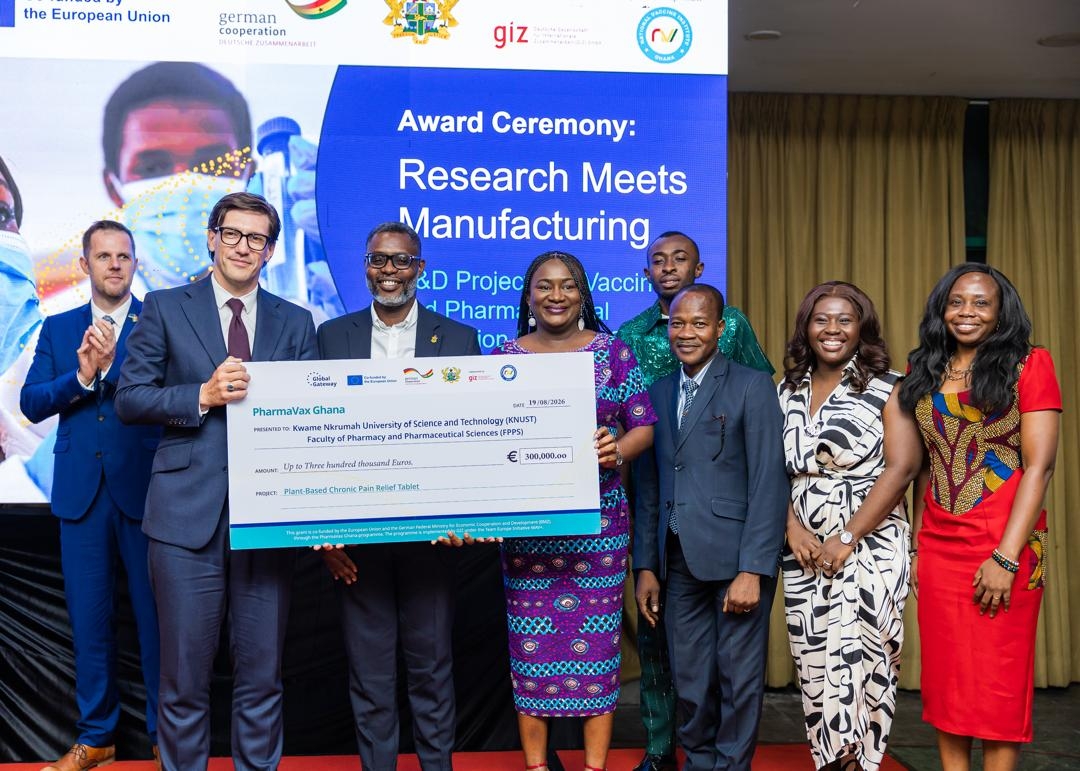
The Faculty of Pharmacy and Pharmaceutical Sciences (FPPS), Kwame Nkrumah University of Science and Technology (KNUST), is leading a €300,000 research and innovation project to develop a scalable, locally manufactured herbal medicine for pain management.
The two-year project is being implemented under the PharmaVax Ghana Programme, which supports pharmaceutical research, innovation and local manufacturing in Ghana. The grant was announced at an award ceremony jointly organised by the National Vaccine Institute (NVI) and the Deutsche Gesellschaft für Internationale Zusammenarbeit (GIZ) on August 19, 2026.
Funded by the German Federal Ministry for Economic Cooperation and Development (BMZ) and the European Union (EU), the programme promotes collaboration among academia, research institutions and industry.
KNUST is implementing the project in partnership with Aspee Pharmaceuticals and the Biotechnology and Nuclear Agriculture Research Institute (BNARI) of the Ghana Atomic Energy Commission (GAEC). The consortium was among eight successful teams selected from 43 applications, with about €2 million awarded across the successful projects.
- From Research to a Scalable Medicine
The KNUST research team comprises Prof. Edmund Ekuadzi, Prof. Priscilla Kolibea Mante and Prof. Mariam El Boakye-Gyasi of FPPS.
The project seeks to develop a promising locally researched herbal pain medicine into a sustained-release tablet suitable for large-scale pharmaceutical production.
According to Prof. Mante, the medicine has shown potential for chronic pain management, but further development has been limited by the availability of the medicinal plant and the existing dosage form. A sustained-release formulation could extend the release of the active constituents, reduce dosing frequency and improve convenience for patients requiring long-term treatment.
A major component of the project will also address the sustainable supply of the medicinal plant. The team will use plant tissue culture techniques to propagate the plant under controlled laboratory conditions and compare the chemical profiles of laboratory-grown plants with those obtained from the wild.
This is expected to provide a more reliable source of raw material while supporting the consistency and quality of the final product.
- Building on KNUST Research
The project builds on research initiated with support from the KNUST Research Fund (KReF) in 2017.
Prof. Edmund Ekuadzi noted that the initial KReF support of approximately GH¢20,000 enabled the team to begin developing the research. The current funding will allow the formulation to be optimised while also addressing the challenge of sustainable medicinal plant production.
The progression from a small internally funded project to an internationally supported, industry-linked initiative demonstrates how sustained investment in university research can move promising discoveries towards real-world applications.
- Linking Academia and Industry
Prof. Mariam El Boakye-Gyasi highlighted the importance of academia-industry collaboration in translating research into products that can reach patients. While universities generate scientific knowledge and innovations, pharmaceutical manufacturers provide the expertise and infrastructure needed for scale-up and commercial production.
Aspee Pharmaceuticals will therefore play a key role in moving the formulation towards industrial production.
Dr. Angela Amponsah Kodua, Managing Director of Aspee Pharmaceuticals, noted that the company's role is to help bridge the gap between laboratory research and commercial manufacturing. Aspee will contribute its manufacturing expertise and regulatory experience to support the development of a quality product suitable for large-scale production.
The project represents an important milestone for FPPS and KNUST. Beyond developing a locally manufactured herbal medicine for pain management, it demonstrates how university research, biotechnology and industry collaboration can contribute to pharmaceutical innovation, sustainable medicinal plant production and Ghana's efforts to strengthen local manufacturing.